

Sugar beet is a significant and unique crop with a high capacity for producing and storing sucrose. It is cultivated in over 108 countries worldwide and holds a considerable share in the global sugar market. According to 2022 statistics, global sugar beet production was estimated at approximately 261 million tons, with Russia, the United States, Germany, France, and Turkey being among its largest producers.
Morphology and Characteristics of Sugar Beet:
Sugar beet (Beta vulgaris L.) is a biennial herbaceous plant with a soft, non-woody stem. Its leaves are arranged alternately and are laminar on the stem, being broad, bright green, and rich; they grow to a height of about 35 centimeters. The leaves grow in a cluster from the plant’s crown and are typically at ground level or slightly above.
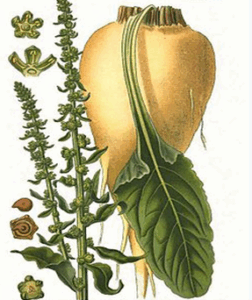
The storage organ of the sugar beet, commonly known as the taproot or beet root, is primarily composed of root and hypocotyl tissues. Sugar beet has a conical, white, and fleshy root with a smooth crown. The plant consists of the root and a rosette of leaves. Sugar is produced through photosynthesis in the leaves and is then stored in the root. The average weight of a sugar beet root is between 0.5 and 1 kilogram. The life cycle of sugar beet is naturally biennial; in the first year, it undergoes vegetative growth and stores sugar in the root, and in the second year, it enters the flowering and seed production stage. In commercial cultivation and regions with cold winters, sugar beet is typically grown as an annual crop, and the roots are harvested before flowering.
Level and Composition of Sucrose in Sugar Beet:
Sugar beet is a plant whose root has a high concentration of sucrose and is cultivated commercially for sugar production. The root of this plant is a specialized organ for storing carbohydrates and typically consists of about 75% water, approximately 20% sucrose, and 5% dry pulp. The sucrose content in the root varies between 12% and 21% depending on the variety and environmental conditions, while the typical sucrose accumulation in commercial roots is 16% to 20%, with high-yielding varieties capable of reaching up to 23%.
The sugar in the root constitutes the most important economic value of sugar beet. Beet pulp, which is mainly composed of cellulose, hemicellulose, lignin, and pectin, is used in animal feed. Sugar beet by-products, such as pulp and molasses, add about 10% to the total value of the crop. Scientific research continues to identify methods for further increasing the sucrose content in the root as well as the highest crop yield per hectare.
Process and Mechanism of Sucrose Accumulation in Sugar Beet:
Sucrose accumulation is a multi-stage process involving the following steps: sucrose synthesis, its transport between the stem and root, utilization of sucrose in the root, and its storage. It was previously thought that cold air triggers sucrose storage, but research has shown that sucrose accumulation occurs throughout the entire growth season and is concurrent with root growth.
There is no specific stage during growth for sucrose accumulation. Numerous factors can influence the amount of sucrose produced and stored. The longer the plant grows and the more light it absorbs, the greater the amount of accumulated sucrose will be. Under ideal growth conditions, a healthy beet achieves the highest sucrose level at the end of the growth season.
Factors Affecting Sucrose Accumulation:
The sucrose content in sugar beet can vary significantly between different harvest years. Research indicates that several factors influence sucrose accumulation, some controllable and others not. Plant genetics play a very important role in this process; different varieties show significant differences in sugar production, and selecting a variety with high sugar content and suitable root yield is essential for maximizing sucrose levels.
However, when selecting a variety, its resistance to diseases must also be considered. Often, varieties with the least resistance to diseases produce the highest sugar content. When genetic breeders enhance disease resistance, the plant’s ability to produce sugar may decrease. These varieties are best planted in fields where those diseases are not prevalent. Advances in plant breeding techniques have made it possible to produce varieties with a combination of disease resistance and high sugar production.
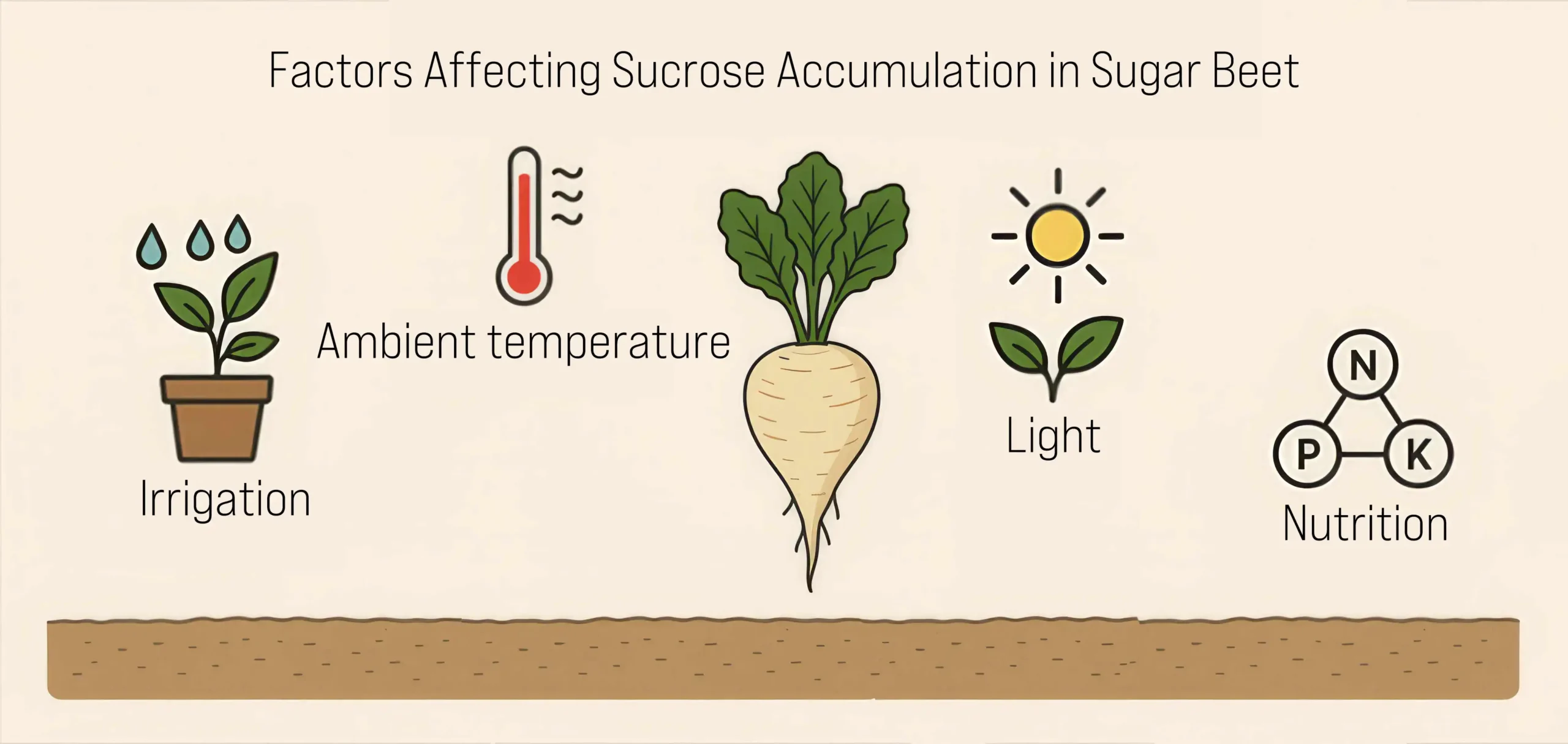
Another factor affecting sucrose accumulation is the plant’s ability to absorb sunlight. The highest solar radiation occurs between [Ordibehesht] and [Mordad] (approx. April/May to July/August), while leaf canopy is not yet complete early in this period, and the fullest leaf canopy is usually established from [Mordad] to [Aban] (approx. July/August to October/November), when sunlight intensity gradually decreases. Summer weather patterns, such as cloud cover, can also limit light availability. Early planting, rapid emergence, and optimal row density increase light absorption and photosynthesis.
Plant nutrition is also highly important. Any deficiency or excess of nutrient elements can affect sucrose production and storage. Nitrogen is the most important element for increasing sugar yield, but its excessive application reduces the sugar percentage because excess nitrogen stimulates leaf growth and increases the water content in the root. Nitrogen programs should be designed to be adequate in the first half of the growth season and reduced in the second half to limit leaf growth and achieve maximum sugar storage.
Diseases also negatively impact sucrose production and storage. Leaf diseases reduce the plant canopy and light absorption, as photosynthetic products are used for leaf regeneration and plant defense. Root diseases, viruses, and nematodes can also reduce water uptake and the plant’s ability to produce and store sucrose. Maintaining the overall health of the plant is a critical factor for sugar accumulation.
Environmental stresses such as water deficit and high temperature also affect photosynthesis and sucrose accumulation. Under moisture deficit conditions, leaf stomata close and photosynthesis decreases. The best sucrose production yield is achieved at temperatures between 17°C and 25°C, and a temperature around 17°C is most efficient for sugar accumulation.
Conclusion:
Sugar beet is a strategic crop with high economic value, whose sucrose content is influenced by a set of genetic, environmental, and management factors. Plant genetics play a decisive role in the ability to accumulate sucrose, and selecting suitable varieties with high sugar content and sufficient disease resistance is key to increasing the economic yield of the crop.
Environmental factors such as light intensity, temperature, and moisture, as well as management factors including planting density, planting time, and nutrition management, particularly nitrogen, directly influence the synthesis and storage of sucrose. Optimal nitrogen application in the first half of the growth season and its limitation in the second half helps maximize sugar storage in the root.
Furthermore, plant health in terms of combating diseases and environmental stresses is crucial for achieving the highest sucrose levels. Leaf and root diseases can limit light and water absorption, thereby reducing photosynthesis and sucrose production. Temperatures between 17°C and 25°C are suitable for optimal sugar accumulation, and temperatures around 17°C provide the highest efficiency.
In summary, integrated management of genetics, environment, and plant nutrition, along with control of diseases and environmental stresses, can ensure maximum sucrose production and storage in sugar beet and play an effective role in improving the yield and profitability of this crop.