

The codling moth (Cydia pomonella L.), from the order Lepidoptera and the family Tortricidae, is a serious pest of pome fruits, such as apples and pears, worldwide. Due to the significant damage it causes to fruits, its control is of particular importance. The management and control of the codling moth are often challenging due to insufficient knowledge of its biology, ecology, and population genetics. This article examines the biology and methods of control and Integrated Pest Management (IPM) of this pest.
Hosts of the Codling Moth:
The codling moth (Cydia pomonella) is one of the most important pests of fruit trees globally. The larvae of this pest consume the fruits of various host species, including apple, pear, quince, hawthorn, crabapple, walnut, apricot, and cherry.
Biology of the Codling Moth:
This pest has been able to adapt to diverse climatic and habitat conditions by forming different ecotypes. The codling moth undergoes complete metamorphosis (holometabolous metamorphosis), which includes four stages: egg, larva, pupa, and adult insect. Each growth stage has its own specific morphological and physiological characteristics.
Adult Insect:
The flight time of codling moths depends on the geographical region and climatic conditions. However, the spring flight of adult moths begins when apple trees are in the late bloom stage.
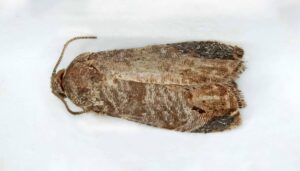
Adult codling moths are 10 to 12 mm in length, and their wingspan is 15 to 20 mm. Their body color is grayish-brown, and the tip of each forewing has a chocolate-colored spot with coppery to golden markings. The hind wings, which are not visible at rest, are a lighter, coppery-brown color.
During the day, adult moths rest on tree bark and are well camouflaged. If the temperature at dusk is between 10 and 15.5 °C, the moths become active, mate, and females lay their eggs. Under similar conditions, moths can also be active at dawn. Each female moth is capable of laying up to 100 eggs.
Egg:
The codling moth egg is the size of a pinhead, flat, and oval. It is transparent when laid and gradually turns white; just before hatching, the black head of the larva becomes visible. These eggs are laid individually on the fruit or the upper surface of leaves near the fruit and are difficult to observe in the orchard. Their incubation period varies from 6 to 20 days, depending on temperature.
Larvae:
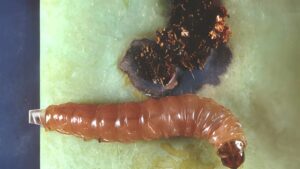
Codling moth larvae pass through five instars over 3 to 5 weeks. Upon hatching, the larvae are about 2 mm long, and their bodies are white with black heads and anal and thoracic shields. The length of mature larvae is between 13 and 19 mm. Their bodies are pinkish-white, and their heads and anal and thoracic shields are brown.
Newly hatched larvae search for fruit and enter it to feed and grow. The entry point can be through the calyx or the side of the fruit. The larvae first eat the first layer of the fruit skin and then either feed just beneath the surface or tunnel directly to the fruit core. Codling moth larvae primarily feed on the fruit seeds. When the larval stage is nearly complete, they create an exit tunnel, which is blocked with frass.
After completing the larval stage, the larvae leave the fruit and construct a thick, silken cocoon under loose tree bark or in another protected location. This cocoon serves as the overwintering site for the larvae.
Pupae:
Codling moth pupae are about 13 mm long and brown in color. The duration of the pupal stage varies between 7 and 30 days, depending on temperature.
Number of Codling Moth Generations:
The number of codling moth generations per year varies depending on the region and climatic conditions, typically reported to be between one and four generations. In warmer regions with longer growing seasons, more generations may occur, making pest management more difficult.
Damage Caused by the Codling Moth:
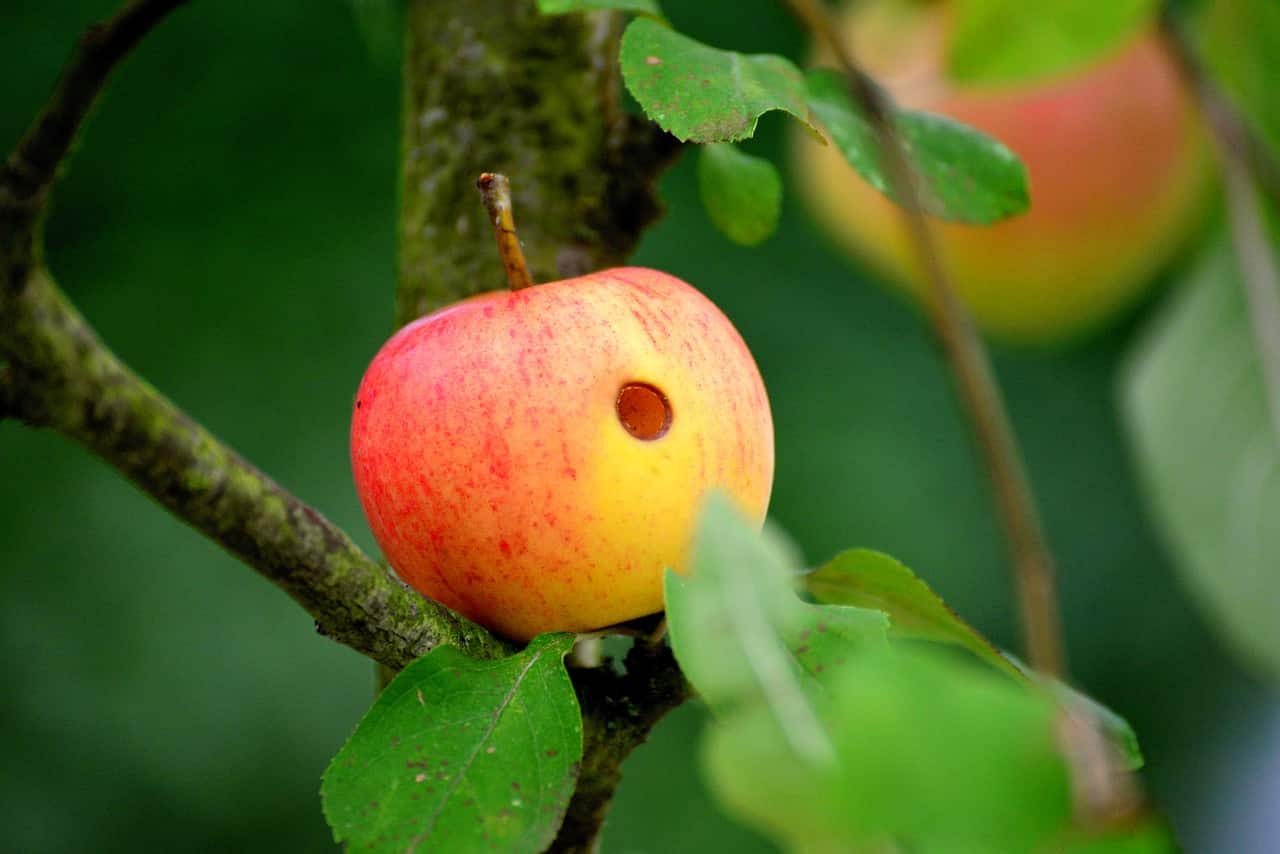
Codling moth larvae primarily feed on fruits and often target areas with less coverage, such as the fruit end, the calyx end, the stem end, or the contact point between two fruits. The entry point of young larvae into the fruit is called a “sting” and appears as a bright red circular pattern. This pest can also infest pears, where larvae mostly enter the fruit from the calyx end. Infestations usually occur late in the growing season.
Although larvae tunnel through the fruit flesh, most of their feeding is on the developing seeds within the fruit core. When the larvae mature, they exit the fruit, creating larger tunnels and leaving behind significant amounts of brown frass. In some regions, the codling moth can infest up to 90% of the fruits.
Difference in Damage Types:
This type of damage, referred to as a “sting,” only causes a surface blemish and, unlike deep tunneling, does not cause internal fruit rot. Fruits with first-generation stings usually remain on the tree, while fruits with deep tunnels often fall during the natural fruit drop in June.
Later generations may or may not cause premature fruit drop; this depends on the fruit cultivar. Deep damage in later generations is a more serious issue, as damaged fruits must be culled, and if not removed, the quality of the product decreases.
Monitoring the Codling Moth:
Monitoring of the codling moth is conducted using Delta traps, which are hung in orchards to capture adult moths. These traps play a crucial role and are used to determine the biofix and specify the timing of adult moth flights (usually two and sometimes three flights per year). Data from adult moth flights help predict egg hatching and larval emergence and allow for estimating the relative population density of adult moths in the area.
Biofix:
Biofix is a biological reference point from which other insect development stages are measured. It is the start of sustained moth flight or when at least two moths are caught in traps on consecutive nights. Accurately determining the biofix date is essential for correctly initiating the codling moth prediction model.
Trap Specifications:
Typical codling moth traps are triangular in shape and have a sticky inner surface. A female sex pheromone is used to attract male codling moths, which is simply placed on the trap’s sticky surface and replaced according to guidelines.
Trap Installation Time and Location:
Traps should be installed in orchards before the start of flowering or when the first apple blossoms open. The installation location is usually on the outer part of the tree canopy, in the upper third of the canopy (preferably 1.5 to 2 meters above ground level), and should be placed so that the trap entrance is not blocked and the trap is parallel to the prevailing wind direction.
Installing at least 2 to 3 traps per orchard is recommended. The distance between codling moth traps from the orchard edge should be about 50 meters, and the distance between traps should be about 50 to 100 meters. It is important to note that adhering to the recommended trap inspection frequency is essential and of high importance. Traps should be inspected at least once a week to check for male moths.
Conditions for Using Traps:
Data from codling moth pheromone traps are an important tool for monitoring moth emergence and effective management of this pest. This data is used to determine the start of degree-day calculations, plan optimal spray timing, estimate the relative population density of moths, and assess the success of the management program.
Traps should be checked weekly, and the number of trapped moths recorded. A count of zero moths does not mean the pest is absent from the orchard, as factors such as unsuitable temperature, insufficient wind, or old and inefficient pheromone lures can result in zero trap counts.
To avoid monitoring errors, cross-contamination of lures or traps between different species should be avoided. Unopened pheromone lures from different species should not be stored together, and a trap that previously had a pheromone lure for another species should not be reused. It is recommended to use the same type of trap and lure each year to allow for comparison of results with previous years.
Codling Moth Management:
Controlling the codling moth, as one of the most important damaging pests in apple orchards and other pome fruit trees, requires an integrated and scientific approach where cultural, biological, and chemical methods are used in a coordinated and principled manner. Below, the most important strategies for controlling this pest are introduced:
Cultural and Educational Management:
Cultural control refers to a set of management practices that help reduce the codling moth population by improving orchard conditions and increasing grower awareness. These measures include educating orchardists to accurately recognize the pest’s life cycle, identify early damage symptoms, determine appropriate control times and use non-chemical methods, as well as continuously monitoring the pest population by installing pheromone traps to determine the precise timing for control.
Agronomic and Sanitary Management:
To reduce the codling moth population, infested fruits should be collected and removed from the orchard, and fruit cluster pruning can improve spray coverage. Collected fruits and those that have dropped due to first-generation larvae should be destroyed. Additionally, plant debris and weeds around the tree base and loose bark on old trees should be removed to reduce pupation and overwintering sites. Individual fruits can be bagged in small paper bags to prevent access by the codling moth.
Using corrugated cardboard or burlap bands around tree trunks can provide a site for codling moth pupation. These bands should be collected and destroyed before the emergence of the first-generation moths and can be reinstalled in early autumn to reduce the density of overwintering larvae. This method is more effective in small orchards with smooth-barked trees and away from sources of moth infestation. Although no apple or pear cultivar is completely resistant to codling moth, cultivars that produce firmer fruits are usually less infested.
Preliminary studies indicate that covering trees with netting can also be effective in reducing codling moth populations. Nets prevent moths from accessing egg-laying sites and reduce moth numbers, although this method is costly and labor-intensive, requiring more research to confirm its effectiveness.
Mating Disruption:
One effective method for controlling codling moth is Mating Disruption. In this method, the orchard is saturated with the female moth’s sex pheromone to reduce the male moth’s ability to find females, thereby delaying or completely preventing mating.
This method is usually recommended for orchards with an area of about 5 to 10 hectares. Regular monitoring is essential to assess effectiveness and determine the need for supplemental spraying alongside it.
Mating disruption is a certified organic method that can reduce reliance on insecticides. Although its initial cost is high, after two to three seasons, it can be more cost-effective compared to traditional insecticide-based management.
This method is more effective in square-shaped orchards than in narrow, rectangular ones, and its simultaneous use in adjacent orchards with sufficient area significantly increases efficiency.
Using this method in newly established orchards is not recommended because young trees lack sufficient foliage to hold the pheromone, and the pheromone substances degrade more quickly.
Biological Control:
The codling moth has several natural enemies that play an effective role in reducing its population. These include parasitic wasps and a group of generalist predators such as assassin bugs, minute pirate bugs, and green lacewing larvae. These natural enemies are particularly more important for supplementary pest control in orchards where no spraying is done or trees are treated with selective insecticides.
Trichogramma wasps have high potential for the biological control of codling moths. These wasps parasitize the pest’s eggs and prevent larvae from emerging. However, since even a single larva can completely destroy a fruit, relying solely on natural enemies is not sufficient for effective control.
Despite this limitation, the release of Trichogramma wasps can be used as a supplementary method alongside Mating Disruption, enhancing the efficacy of integrated pest management.
Chemical Control:
In the home and garden market, only a limited number of insecticides are available for managing codling moths. These insecticides must be applied concurrently with egg-laying and egg hatching and with complete coverage of the fruits. To prevent the development of resistance in the pest population, it is recommended that insecticides with different modes of action be used in rotation.
Pesticide application should be intelligent and based on scientific principles. These principles include:
-
Regular monitoring and attention to the economic injury threshold.
-
Use of selective and low-risk pesticides.
-
Rotating pesticides to prevent the development of resistance in the pest population.
Summary:
The codling moth (Cydia pomonella), as one of the most important economic pests in pome fruit orchards, causes serious damage to the quantity and quality of the crop. Successful management of this pest requires a comprehensive understanding of its biology, life cycle, and ecological behavior. The results of studies and practical experiences show that the integrated and coordinated use of various management methods, including cultural and agronomic practices, utilization of natural enemies, targeted application of insecticides, and modern methods like mating disruption, can significantly increase control effectiveness.
The Integrated Pest Management (IPM) approach not only helps reduce dependence on insecticides and prevent the development of resistance but also ensures ecological balance and production sustainability. Therefore, implementing IPM in codling moth management programs can be considered a sustainable and efficient solution for producing healthy fruit and protecting the environment.